Biography
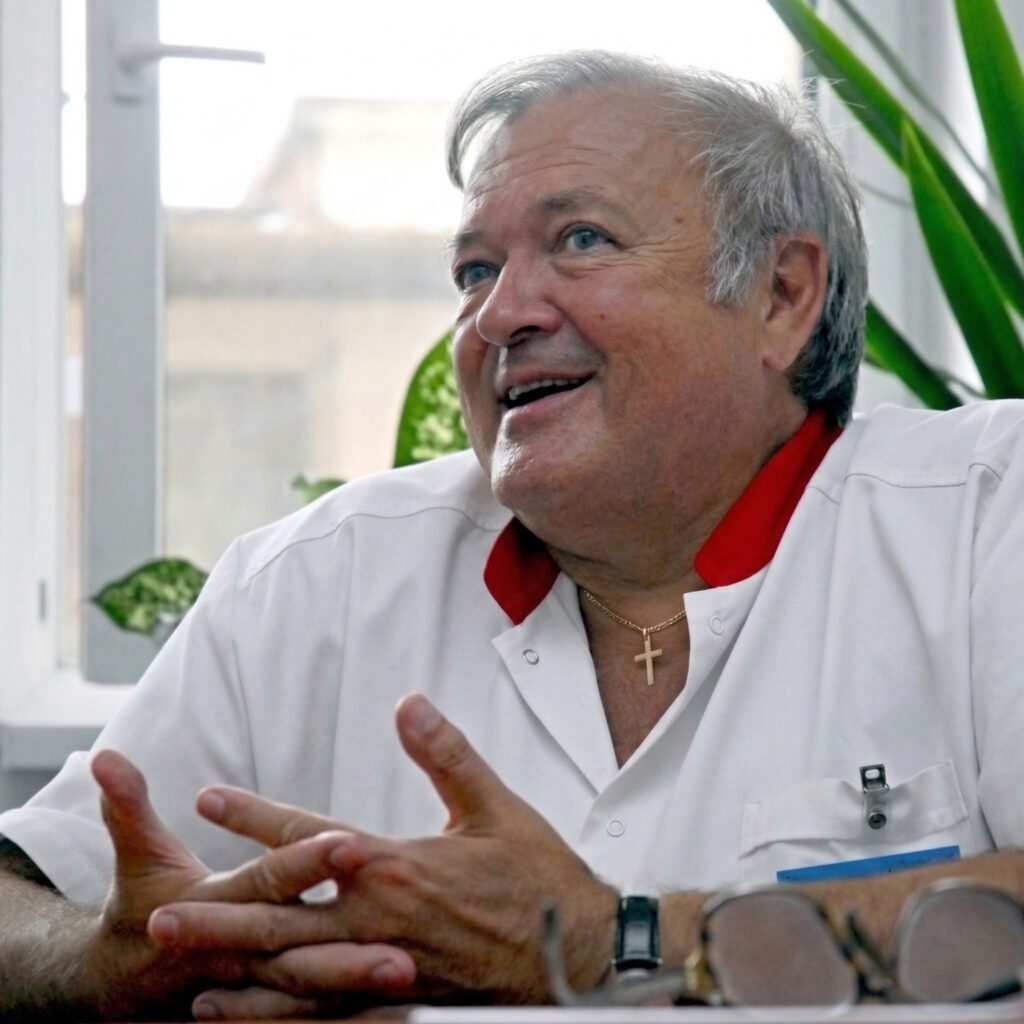
Professor Nicolae Miu, MD, PhD (1942–2024)
Childhood and Origins
Nicolae Miu was born on October 23, 1942, in Turda, Cluj County. His childhood was marked by a painful yet defining absence: his father, Nicolae, a librarian by profession, was taken as a prisoner of war in the Soviet Union, returning to the family fold only in 1949. Thus, young Nicolae only came to know his father at the age of approximately seven, having been raised until then by his mother, Elena, and his aunt, Lucreția, both of whom were educators.
“You are kind to a fault, just like your father!” his mother would tell him—not with malice, but as a tender observation. They were different natures: the mother, sterner and more categorical; the father, gentle and forgiving. Nicolae Miu would acknowledge throughout his life that he inherited his father’s kindness, but that his mother’s strictness also served him well at times. This balance between rigor and kindness would come to define his entire career.
His mother, an educator who lived within the kindergarten courtyard, instilled in him a love for children from an early age—Nicolae effectively grew up alongside entire generations of children. It was also she who later intuited that her son’s sensitivity was perfectly suited for the profession of a pediatrician.
School, Opera, and Medicine
After the family moved to Cluj, Nicolae Miu attended the prestigious “Emil Racoviță” High School, graduating in the class of 1960. This was an institution of great value, the successor to the Interwar University Pedagogical Seminar of Cluj. Here, he benefited from exceptional teachers who molded his critical spirit and left an indelible mark on him. He remembered with particular gratitude his class headmistress, Olimpia Comșa, a natural sciences teacher who had a decisive influence on his formation.
From the age of eight, Nicolae Miu began frequenting the Romanian Opera in Cluj, experiencing with intensity the performances of the great Romanian soloists. The figure who impacted him most profoundly was the soprano Lya Hubic, dubbed the “Nightingale of Transylvania”—an artist who performed over 2,000 shows and for whom young Nicolae held boundless admiration.
His dream was to become an opera singer. He possessed a beautiful bass-baritone voice, and his high school teachers and colleagues considered him to have an artistic temperament. He took singing lessons and prepared seriously for this path. However, at the Conservatory, the number of places available for his voice type was very limited. He traveled alone to Constanța to take the admission exam, but his father followed him and brought him back to Cluj, guiding him toward the Faculty of Medicine.
He sat for the Medical School admission exam, which he passed. The first two years of faculty seemed “extremely hard and rigid” to him, as he struggled to understand the purpose of preclinical subjects, and he was tempted to leave Medicine in favor of singing. However, in his third year, upon reaching the patient’s bedside, he truly discovered medicine. An empathetic nature, he understood even then the necessity of closeness to the patient and began to participate in their suffering in an attempt to help them.
Among his mentors at the faculty were professors of high caliber: Ion Manta in biochemistry, Gheorghe Badenski in microbiology, Octavian Fodor in internal medicine, and Iuliana Țîrlea in pediatrics. But above all, Professor Octavia Mărgineanu was the one he considered his “Maestra,” and whose name he always pronounced with emotion. Prof. Mărgineanu discovered him, constantly tested him, and formed him into an exceptional diagnostician.
He graduated Medicine in 1966 with a Diploma of Merit. Meanwhile, he did not abandon music: he studied singing for three years at the Popular School of Arts, an experience which, he said, “illuminated his heart, ennobled his soul, and made him understand how close medicine is to art, through sensitivity and dedication.”
Also during university, he met Aurora, a medical student who became his wife in 1966. The first opera they attended together was Puccini’s La Bohème—a coincidence full of symbolism, as Lya Hubic had debuted on the same stage in the very role of Musetta in La Bohème.
His professional debut was not a comfortable one. In the political context of the era, following Ceaușescu’s decree banning abortions, no difficult district in the country could remain without a doctor. Nicolae Miu was assigned to Ponor, beyond Râmeț, in a village with an eight-bed stationary unit and a maternity ward serving eight hamlets. It was a harsh experience, but a defining one: youth and ambition prevailed.
Pediatrics Clinic II: A Life, An Opus
After Ponor, Nicolae Miu sat for the exam at the Pediatrics Clinic II within the Emergency Clinical Hospital for Children in Cluj, where he began as an intern assistant. From here, he climbed every hierarchical step and never left. Pediatrics Clinic II was his professional home, the stage on which he built his opus.
His academic path was rigorous and consistent, always at the same clinic: resident between 1968 and 1971, university assistant from 1971, Doctor of Medicine in 1974, lecturer between 1980 and 1988, associate professor from 1988, and full professor from 1992, eventually becoming Head of the Clinic.
As a physician, he obtained the title of primary physician in three distinct specialties: Pediatrics (1980), Gastroenterology (1994), and Diabetes, Nutrition, and Metabolic Diseases (1999)—a triple competence that allowed him an integrated vision of child health.
His doctorate was a national premiere: the first study in Romania regarding the role of magnesium in child biology and pathology. Together with Prof. Octavia Mărgineanu, he wrote the book “Trace Elements in Biology and Pathology” (1984).
The achievement of which he was perhaps proudest—though his legendary modesty would not let him say it directly—was the construction of the new building for Pediatrics Clinic II. “An achievement that, as the elders say, probably cost me years of my life, but I do not regret it,” he confessed. The building radically transformed the conditions of childcare, becoming a landmark of Cluj pediatrics.
Another major institutional contribution was the establishment, in 1994, together with Dr. Aurel Bizo, of the Pediatric Renal Dialysis Section—a premiere in Romania, the first unit of its kind separate from that of adults. This decision came from a deeply personal pain: Professor Miu had seen children with renal failure arriving without hope, and he swore that if he became head of the clinic, he would create a section dedicated to them. He also created a Medical Center for Adolescents—another pioneering step, through which his vision of adolescent medicine gained a concrete institutional framework.
Founder of Schools and Thought
Prof. Nicolae Miu was a creator of durable professional structures. He founded and led the Romanian Society of Pediatric Gastroenterology, Hepatology, and Nutrition, simultaneously creating a reference center in pediatric gastroenterology at Pediatrics Clinic II, where he trained generations of specialists from across the country. He was also a founding member of the Romanian Society of Social Pediatrics, serving as its president—and later, between 2016 and 2020, as honorary president—organizing national congresses starting in 1995, in which he also included themes regarding therapy through physical education. He also held the position of Vice President of the Romanian Society of Pediatrics.
He introduced into Romania, for the first time, fundamental concepts such as adolescent medicine and social pediatrics, understanding the child and the adolescent as beings situated in a complex familial, psychological, and social context, not merely a biological one. He also contributed to the promotion of physical education in children and adolescents, inspired by the model of Professor Iuliu Hațieganu, supporting the organization of the First National Conference “Medicine Applied to Physical Education and Sport” (2013).
His scientific work is vast. Among his most important works are: “Treatise on Adolescent Medicine” (1999, Casa Cărții de Știință, approx. 700 pages)—a pioneering work in Romania; “Trace Elements in Biology and Pathology” (with Prof. Octavia Mărgineanu, 1984); “Liver Pathology in Children” (with Georgeta Fărcaș, 1992); “Bronchial Asthma in Children—Current Trends and Perspectives” (with G. Sur, 1996); “Von Willebrand Disease” (with G. Sur, 1996); “Juvenile Rheumatoid Arthritis” (with G. Sur, 1996); “Therapeutic Strategies in Metabolic and Digestive Diseases in Children” (with Antonia Popescu); “Digestive Tract Malformations in Children” (with H. Gocan and L. Marți); “Chronic Hepatitis in Children: Progress in Diagnosis and Treatment” (with R. Badea and Luiza Burac, 1999); “Memories from the Cluj Opera Hall” (2000), as well as university courses in pediatrics.
The Academic Leader
His career at the “Iuliu Hațieganu” University of Medicine and Pharmacy (UMF) was one of continuous construction. After 1989, he held top-level leadership positions: Vice-Dean of the Faculty of Medicine (1990–1992), Didactic Vice-Rector of UMF “Iuliu Hațieganu” (1992–1996), and between 2000 and 2008, Dean of the Faculty of Medicine. He was also President of the College of Physicians Cluj (1997–2001).
As Dean, he imposed new standards and brought important curricular innovations, among which was the introduction of the Behavioral Sciences discipline—a national premiere. In 2004, he published the course of the same name under his editorship, the first manual in this specialty to appear in Romania, understanding that a good doctor must also be a keen psychologist in the relationship with the patient.
He trained entire generations of students, doctors, and doctoral candidates. He had the gift of discovering talented disciples, whom he channeled onto the most suitable path. Over 50 Doctors of Medicine were formed under his guidance. The “Pediatric Regals” of Thursday mornings—magisterial presentations followed by classical music—remained in the memory of colleagues as moments of rare scientific and artistic metamorphosis.
The French Chapter
The moment of professional and cultural turning point occurred in the years 1974–1975, when he won a French government scholarship and worked at L’Hôpital des Enfants-Malades in Paris—the cradle of world pediatrics. The experience was not just a clinical internship, but a revelation of modern Western medicine, which he became ambitious to implement at home in Cluj. From there, he brought back the concept of Behavioral Sciences, which he then introduced into the student curriculum.
He remained a convinced Francophone and an ambassador of French culture in medicine throughout his life. For several years, he was Vice President of the International Conference of Francophone Medical Deans—a position that allowed for a permanent confrontation with international standards and to which he made a real contribution. He was also a member of the French Society of Pediatrics and the Francophone Group of Pediatric Gastroenterology, maintaining a living bridge between Cluj and the Francophone medical world.
Distinctions and Recognition
His achievements were honored at the highest level:
- Knight of the National Order of Merit of France — awarded in 2004 by President Jacques Chirac, for strengthening Franco-Romanian relations in medicine.
- Order of Sanitary Merit in the rank of Grand Officer — awarded in 2004 by the Romanian Presidency.
- “Iuliu Hațieganu” Prize of the Romanian Academy (1997 and 1999).
- Diploma of Excellence from the Ministry of Education.
- Title and Medal “Senior of the Citadel” (2009, Cluj Opera Ball).
However, he was reserved when it came to awards and distinctions. “Of course, my activity was appreciated, but I like to talk about this less,” he confessed in an interview.
Music: The Second Life
Professor Miu refused to be one-dimensional. He who could have become a great soloist remained throughout his life close to the opera, a constant and passionate spectator of the Romanian Opera in Cluj.
His book, “Memories from the Cluj Opera Hall” (2000), is not a simple reading, but a testimony of decades spent in performance halls, a warm evocation of a golden age. He was a protector of the memory of the great soprano Lya Hubic—”The Nightingale of Transylvania”—ensuring that the name of this absolute artist would not be forgotten.
He participated in numerous editions of the “Medicine, Art, and Culture” Galas, organized by UMF “Iuliu Hațieganu” in partnership with the Romanian Academy – Cluj-Napoca Branch and other cultural institutions in Cluj. Music was not an ornament for him, but a form of knowledge, of inner modeling, a bridge between scientific rigor and the vibration of the soul.
Medicine and Theology
He was a constant presence at the International Seminar of Medicine and Theology in Bistrița, alongside personalities such as hierarchs, intellectuals, and, among others, his friend Mircea Gelu Buta. Here he lectured on themes of great human and professional finesse—including trauma psychotherapy in pediatric practice. He advocated for the dialogue between science and faith, arguing that the healing of the body without the comforting of the soul is incomplete. Regarding his achievements, he said: “I believe I would not have succeeded in having all these achievements if I had not felt Jesus within me or beside me.”
His professional creed remains: “Without trust in the One Above, everything you do… is not enough.” And in three words, he summarized the quality medical act: “Profession, humanism, and faith.”
Family
For Professor Nicolae Miu, family was not a secondary chapter of his life — it was its centre. He felt best when surrounded by his loved ones, and solitude was never his friend. He supported everyone, in absolutely everything, with a generosity that knew no conditions or limits.
In his personal life, he had by his side Aurora Miu, a respected ophthalmologist, to whom he was a devoted husband from 1966. They had two children: Bogdan Ioan and Daniela Aurora — each carrying forward, in their own way, something essential from their father’s spirit.
Bogdan Ioan followed the path of physiotherapy, working with children in rehabilitation — a vocation he absorbed, as if by osmosis, from the atmosphere in which he grew up. The love for children clung to him from a young age, living day by day in the presence of a father for whom every child was a world unto itself. From his father he also inherited a literary talent that those close to him readily recognise. After Aurora’s passing, Bogdan was the one who cared for Professor Miu with constant and quiet devotion, staying by his side until the very last moment.
Daniela Aurora was, in the family’s words, “daddy’s girl” — the bond between them was always special, and after Aurora’s death it deepened even further. Precisely for this reason, his loss struck her the most profoundly. From Nicolae Miu, Daniela took the ambition, the work ethic and the love for music — she studied piano and ballet, and later enrolled all three of her children in music, passing on what she herself had received. Today she is a university professor and head of the Biophysics department at “Iuliu Hațieganu” University of Medicine and Pharmacy in Cluj-Napoca.
Daniela married Dr. Dan Eniu, a highly regarded surgical oncologist. Their story has a beautiful root: Dan Eniu was Professor Miu’s student at the faculty, and Miu noticed him from the very beginning. The relationship that formed between them illuminated not only Dan’s medical career, but above all their personal and family life — making him, over time, a son by choice. In the final months of the professor’s life, Dan Eniu was the one who provided his medical care, with the same skill and devotion he brought to the operating theatre.
Through the family of Daniela and Dan, the grandchildren came into the world: Vlad, Mihai and Mira, who affectionately called him “Tin-Tin” — something that brought him immense joy.
Professor Miu saw his dream of a musical career fulfilled through his grandson Vlad, who graduated from the Conservatory, pursued a master’s degree in Milan — where his grandfather visited him and they went to the opera together — and then earned a doctorate in music, becoming an orchestra and choir conductor. But the story did not end there: Vlad also pursued Medicine, becoming a resident in obstetrics and gynaecology. A coincidence full of meaning: obstetrics and gynaecology was precisely the alternative that Professor Miu had once had in mind had he not chosen paediatrics. He was overjoyed when his grandson chose his residency placement and when he began his first days in the hospital — even though, deep down, he would have very much liked Vlad to have chosen paediatrics. In fact, Vlad had accompanied him many times to the clinic on Porumbeilor Street, sitting in on consultations and absorbing, without knowing it at the time, something of his grandfather’s art of being a doctor.
Mihai pursued sound engineering, also carrying forward the musical thread of the family, and then turned towards IT, becoming a programmer. Professor Miu supported him without hesitation in this direction, recognising with clarity that each person is suited to a different path — and that your duty as a grandparent is to see it, not to impose it.
Mira, the youngest, was the family’s miracle — born later, during a difficult time, that of their grandmother’s illness. Her presence soothed a suffering that nothing else could soothe. She studies ballet, bringing grace and light to a family in which art and medicine have always been intertwined.
In 2009, Professor Miu’s life was shaken by the illness of his wife Aurora, whom he lost in 2011, after two years during which he cared for her with total devotion. He found his balance again alongside his children, grandchildren and friends, continuing to see patients at the clinic on Porumbeilor Street — children from across the country and even from abroad — until the very last moment of his life. But his true healing was them — his family — their constant presence, their noise, their questions, their visits. For a man who lived his life giving, the greatest joy was to be surrounded by those to whom he had given everything.
Final Years and Departure
In his final years, when health problems began to be felt, Professor Nicolae Miu was cared for with love and devotion by his children and his son-in-law Dan Eniu, who were close to him every day, watching over him with the same care he had accorded a lifetime to his patients. Dr. Dan Eniu, a surgical oncologist, was a discreet and constant support, a son by choice who understood that the duty to care is not just a medical act, but an act of love.
Professor Nicolae Miu passed away on January 4, 2024, at the age of 81, after a career of over 50 years dedicated to children. He died as he lived—quietly, without spectacle, with faith in his soul.
The funeral service was officiated by Metropolitan Andrei of Cluj and Father Ioan, the abbot of the St. John the Baptist Monastery in Alba-Iulia, in the presence of hundreds of colleagues, professors, disciples, parents, and children. The tributes paid that day outlined the portrait of a man who placed his entire life in the service of medicine, of the good, and of his fellow men.
His legacy is not measured in positions held or distinctions received. It lives on in the medical school he consolidated, in the clinic he raised from the foundations, in the professional societies he founded, in the over 50 doctors he trained, in the thousands of children he healed, and in the cultural memory of a city he loved with lucidity and passion.
Professor Nicolae Miu remains one of those rare personalities for whom professional excellence cannot be separated from family, kindness, culture, and faith. A man who sanctified the place.
V.E.